Cloth or not?
Have you ever wondered how much money you would spend if you only use disposables?
We did some calculations and the amount is frightening. Over the first two years you could spend more than $2000, that’s not including things such as the nappy sanitising systems, nappy sacks, wipes etc.
Even if you bought new cloth nappies with every child the money you would save before the baby is 6 months old is worth the cost.
Birth to 4 months – 12 Nappies per Day – approximately 1460 – $462
4 to 6 months – 10 Nappies per Day – approximately 608 – $231
6-12 months – 8 Nappies per Day – approximately 1460 – $693
12-18 months 6 Nappies per Day – approximately 1095 – $528
18- 24 months 4 Nappies per Day – approximately 730 – $363
Now think of cloth and what you would spend in the same two years.
At Mitch‘n’Moo we recommend 24-30 nappies as a minimum to give yourself a two day wash cycle. Two days’ worth of Mitch’n’Moo Originals costs only $570, or even less if you buy value packs. That is over $1500 savings in the first two years per child. Even adding the extra washing into the mix, the additional cost is not even close to the cost of disposables. I didn’t even notice any increase in water bills or electricity after our son was born, and once I got into a routine I didn’t notice the extra loads of washing either.
You hear many arguments both for and against Cloth Nappies; the truth is it’s a personal choice. For me it’s not just about financial savings or the fact that there is still not conclusive evidence to show how long a disposable nappy takes to breakdown as landfill. My main reason is that within a few days in disposables my son will always end up with a reddened bottom, whereas in cloth nappies he rarely ever gets nappy rash.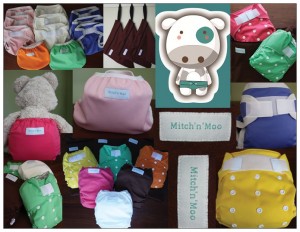
According to the Australian Bureau of Statistics there were 297,900 births registered in Australia in 2010. If you change your baby’s nappy every 2 hours for the first four months of his/her life (as recommended by the World Health Organisation), and if every parent in Australia used disposables, there would be 428,976,000 disposable nappies going to landfill. That’s just for the first four months! Approximately 5% of Australian babies use cloth nappies and even this number hugely reduces the amount of landfill currently sitting at the tip. Just think, if everyone swapped one disposable a day for a cloth nappy the reduction would be massive.
When I started my business and was researching all the benefits of cloth I discovered some amazing facts that most people aren’t aware of. For example, even using disposables you are meant to flush all poos down the toilet first before placing them in the bin. In fact it is against most council rules and regulations to put human waste into the rubbish. Take a close look at your nappy packet next time you’re changing your baby and you will also see in very small writing the same details. Just think for one second what happens to the by-products of a nappy if and when it does decompose and return to the ground and the ground water.
There are many questions and options out there when making the choice wether to use cloth or disposable nappies. Do you buy flats or MCNs; snaps or Velcro; front snaps or side snaps; cover or no cover? The list goes on and on and can be a confronting and confusing time for most.
What works for one may not work for another; all babies are different and nappies fit differently. What works for Mitch doesn’t work as well for other babies. I also found that what worked when Mitch was a newborn doesn’t work in the same way now that he’s a toddler.
There are so many different choices; trying to get your head around what sizes to get, what type of materials are best, it can be daunting to say the least.
The various components for cloth nappies are made from a variety of fabrics. Bamboo, cotton, hemp or fleeces are the main ones, with PUL or wool often used for covers. PUL is a breathable polyurethane laminated fabric that provides a waterproof barrier. Wool is lanolised to provide water resistance, and needs airing rather than washing when wet, and relanolising every couple of weeks.
The type of fabric used affects drying time. Natural fibres usually take longer to dry than synthetics. If you prefer natural fibres, you’ll want to make sure you have enough nappies to get through a few days of wet weather – or get a tumble-drier. Check the laundry-care information before you buy.
Pre-folds are unshaped cloth nappies with several layers of cloth for absorbency, used with a leak-proof outer layer. This style of nappy is the cheapest of the modern variety, although you still have to include the cost of the cover.
Covers can be PUL, woollen soakers, or fleece. One cover should last for up to four or five nappies before it needs washing. We recommend that you use two each day, alternating at each change to allow the other to air out in between.
Fitted nappies look more like disposables with the same “fitted” shape around the legs and waist. They’re usually made from absorbent material such as bamboo, hemp, cotton or fleece. Like pre-folds, they’re used with a waterproof cover.
Pocket nappies have a waterproof outer layer sewn together with a soft inner lining. Between these two layers, there’s a gap (a “pocket”) where you put one or more absorbent inserts. The inserts need to be removed before washing and replaced afterwards, which can be a bit fiddly, but the upside is the nappy tends to be slim lined.
All-In-Ones (AIOs) combine the nappy’s different layers into one. They have a moisture-resistant outer layer sewn together with an absorbent inner to form the nappy. This means there’s no fussing around with separate layers, which is useful when you’re out and about. The extra bulk of all-in-ones does mean they can take longer to dry; though this is dependent on type of fabric.
All-In-Twos (AI2s) consist of a lined waterproof shell and one or more snap-in absorbent layers or boosters, which are taken apart for laundering. Offering faster drying times than AIOs, if you re-assemble them after laundering, they’re conveniently in one piece and ready to go. AI2s are also sometimes called snap-in-ones.
Then there’s the sizing! Cloth nappies come in various sizes, and sizing can differ between brands. Some brands are available in small, medium and large; otherwise it’s one-size-fits-most (OSFM). Some offer both options. The one-size-fits-most has extra fastenings for adjusting the nappy as your baby grows. These nappies will get more wear and tear because you’re using them all the time (something to consider if you want them to last for a second child). The alternative is to buy bigger sizes as needed; you’ll need to buy more nappies but they should last longer.
Costing based on Huggies bulk packs from Coles and Woolies at $33 per box and Raising Children Network average nappy changes per day. W.H.O. World Health Organisation recommends nappy changes every 2 hours, birth rates from Australian Bureau of Statistics.